

Drone Technologies
Wharton Technologies develops integrated drone power, autonomy and payload systems for long-endurance operations across industrial, maritime, offshore and emergency-response environments.
Our approach combines onboard power generation, modular airframe integration and AI-operated control to increase mission uptime, payload capability and operational flexibility.

Autonomous H2 Heavy-Lift Systems
Wharton Technologies is developing autonomous heavy-lift drone platforms for continuous cargo movement across ports, vessels, offshore facilities and industrial sites.
The system combines Wharton’s proprietary phase-change liquid H2 fuel blend, dedicated onboard generation for each rotor, plasma solid-state battery buffering and AI-controlled lift management.
Two primary configurations support different mission classes: a 22 ft two-propeller platform for container and factory logistics, and a 43 ft three-rotor platform with center-stanchion support for longer offshore steel-container-compatible loads.
Dual Platform Configurations
Wharton’s heavy-lift architecture can be configured around cargo dimensions, operating environment and mission-specific lift requirements.
20 Foot Two-Propeller Platform

Designed around a 20 ft cargo envelope, the two-propeller platform uses one dedicated onboard generator per rotor.
Approximately 7 ft blades support lower-clearance approach, lift and placement in ports, factory yards and land-based logistics environments.
Configuration highlights
-
Two primary lift rotors
-
One onboard generator per rotor
-
Designed for 22 ft cargo operations
-
Lower-clearance positioning and placement
40 Foot Three-Rotor Stanchion Platform

Designed for 40 ft offshore steel-container-compatible loads, the larger platform uses a three-rotor configuration with center-stanchion support. The architecture distributes lift across longer cargo and supports controlled placement in offshore, tanker-support and heavy maritime environments.
Configuration highlights
-
Three primary lift rotors
-
One onboard generator per rotor
-
Center-stanchion load support
-
Designed for longer offshore-compatible cargo
Compact Loading Drone

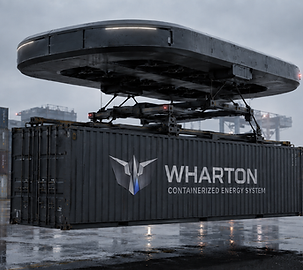
The Compact Loading Drone is engineered to move full-scale cargo and containerized systems through ports, industrial sites and remote operating environments with minimal supporting infrastructure. Its low-profile oval architecture integrates the Wharton Whisper Blade System for exceptionally quiet lift, while a distributed propulsion layout provides stable handling during loading, transport and placement. The platform can be configured to carry 45-foot steel containers, including Wharton Containerized Energy Systems, directly between staging, deployment and operating locations.
Drone Anti-Gravity Floating City
Wharton Technologies is developing a new class of airborne hospitality platform designed to combine high-speed global travel with luxury accommodations, dining, entertainment and panoramic observation spaces. The current development configuration integrates distributed lift, hybrid propulsion and recessed drone-taxi docking within a pressurized floating destination targeting cruise speeds of up to 600 mph.


Built for Diverse Operating Environments
A shared airframe, power and autonomy architecture allows the platform to be configured around different cargo, infrastructure and environmental requirements.
Maritime Shipping
Offshore Operations
Land and Factory Loading
Fuel and Tanker Logistics



Autonomous ship-to-dock and dock-to-ship cargo transfer for continuous port and maritime logistics operations.
Remote movement of equipment and steel-compatible cargo between vessels, offshore platforms and marine facilities.
Factory-yard, warehouse and production-campus transfer across loading bays, staging areas and industrial logistics routes.
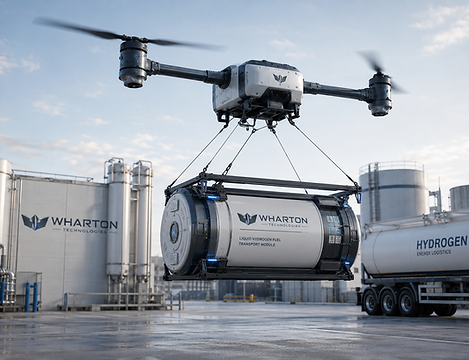
Transport and placement of sealed fuel modules and cylindrical tank systems for road-tanker, terminal and industrial energy operations.

Integrated Onboard Power Architecture
Wharton’s drone platform combines proprietary fuel, rotor-specific onboard generation, solid-state energy buffering and autonomous control within one scalable operating system.

Phase-Change Liquid H2 Fuel Blend
Rotor-Specific M.I.G. Units
Plasma Solid-State Battery Buffer
AI Flight and Payload Control

Micro Induction Generator
Flight configuration utilizes a generator-per-rotor design, allowing onboard generation to scale with the number of lift rotors. Wharton’s M.I.G. features a robust solid-state onboard generator with a scalable output from 45 to 350 kW per unit, equipped with dynamic throttle control and rapid load response. This specification confidently includes capabilities for in-flight start and restart, operation in all flight orientations, and compatibility with maneuvers and high-G conditions.

Proprietary Phase-Change Liquid H2 Fuel Blend
Wharton’s proprietary phase-change liquid H2 fuel blend is designed to reduce fuel-system weight by up to 78.65% compared with currently utilized fuel architectures, depending on configuration and mission profile.
Reducing the fuel-system weight burden allows more of the aircraft’s operating capacity to be directed toward payload, endurance and mission continuity.
In select configurations, the platform may support onboard fuel production, enabling extended autonomous deployment cycles where landing requirements are primarily driven by scheduled preventive maintenance checks and services.

Plasma Solid-State Battery Integration
Wharton plasma solid-state batteries provide onboard energy buffering for rotor response, peak-load demand, autonomous navigation and mission continuity.
The current program target includes a 1 MW-capable plasma solid-state battery module and up to 24 hours of system runtime, depending on payload, duty cycle, environmental conditions and final configuration.
Versatile Scalable Integration
The M.I.G. and supporting fuel and power modules are designed around platform-specific weight, volume and mounting requirements.
Modular integration allows the architecture to scale from compact UAV applications to heavy-lift industrial platforms while maintaining service access, payload flexibility and mission-specific configuration options.

Advanced Reliability
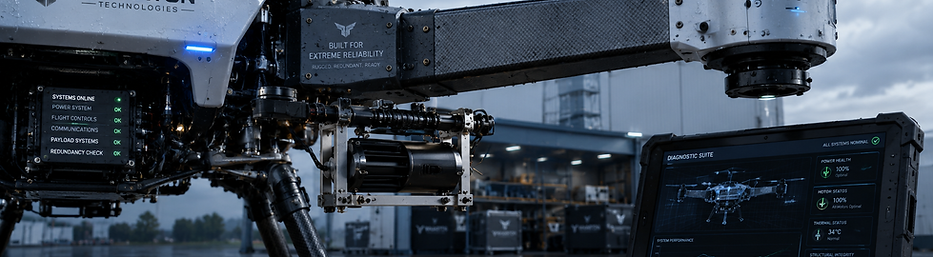
Ruggedized containment, redundant power paths, conservative thermal margins, emergency shutdown and continuous diagnostics are designed to protect the airframe and maintain mission continuity.
Serviceable modular components support planned maintenance and rapid inspection without compromising system integrity.
Extreme Climate Operations
Wharton drone systems are engineered for operation in severe cold, extreme heat, moisture, dust, salt exposure, and remote environments where conventional aircraft access may be limited.
Beyond industrial cargo movement, the platform can be configured for mountain extraction, wildfire evacuation support, coastal operations, scientific deployment, remote recovery, and other time-critical missions.
Designed for an operating range of −60°C to +270°C, the system incorporates protection against dust and water intrusion, prolonged maritime exposure, and sealed submerged operating conditions.

One Autonomous Platform Across Multiple Environments
Wharton’s drone architecture connects offshore assets, commercial ports, manufacturing facilities and inland energy operations through a shared fuel, power and AI-control system.
The result is a scalable logistics platform designed to move cargo, equipment and energy infrastructure across environments that are normally separated by fixed transport systems.
