


Advanced Water Treatment
Cavitation-Based Treatment for Complex Water Challenges
Wharton Technologies develops configurable water-treatment systems for PFAS remediation, industrial cleanup, drinking-water applications and resilient infrastructure.
Our Process
One Platform. Multiple Treatment Objectives.
Wharton’s cavitation technology is engineered to address complex water challenges through a configurable treatment process.
Each system is designed around the source-water chemistry, contaminant profile, required treatment volume and final water-quality objective. Depending on the application, cavitation may be combined with separation, filtration, concentration handling, mineral balancing or final polishing.


PFAS Remediation
Addressing Persistent Water Contaminants
Per- and polyfluoroalkyl substances present a significant challenge for industrial facilities, municipalities and communities managing contaminated water.
Wharton’s cavitation platform can be configured to support PFAS remediation as part of a project-specific treatment strategy. Depending on the source water and treatment objective, the system may be combined with concentration, separation, filtration or polishing technologies.
Every PFAS project begins with water characterization, compound-specific analysis and validation against the required treatment target.
Treatment Capabilities

PFAS and Persistent Contaminants
Supports project-specific treatment strategies for PFAS and other difficult water contaminants.
.png)
Dissolved Minerals and Unwanted Constituents
Addresses mineral loading, dissolved material and other constituents affecting water quality or system performance.
.png)
Suspended Solids and Turbidity
Supports the removal of sediment, particulate matter and suspended material from complex water streams.

Biological Contaminant Control
Can be integrated into treatment strategies addressing bacteria, viruses and other biological contaminants.
.png)
Industrial Process-Water Contamination
Designed for process-water cleanup, recovery, reuse and treatment of industrial water streams.
.png)
Brackish, Saline and Reuse Applications
Supports treatment of brackish water, saline water and reclaimed water intended for reuse or further polishing.

Industrial Water Treatment
Treatment, Recovery and Reuse
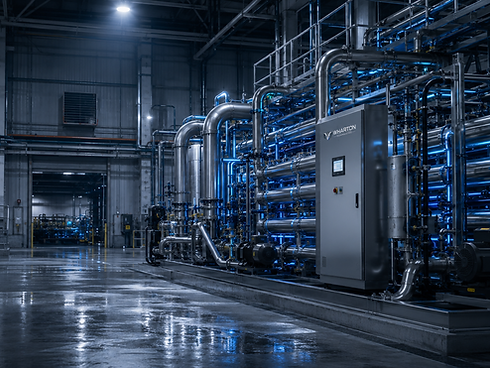
Heavy manufacturing and industrial operations can produce water streams containing suspended solids, minerals, process residues and other unwanted constituents.
Wharton systems can be configured for new installations, treatment-system retrofits or integration into existing industrial infrastructure.
Municipal and Drinking Water
Reliable Water Treatment for Communities
Wharton’s treatment platform can be configured for municipal, community and potable-water applications requiring dependable water quality and scalable infrastructure.
Potential deployments range from established municipal systems to remote communities, emergency installations and future infrastructure developments.
Process-Water Recovery
Recover and reuse water within manufacturing and industrial operations.
Municipal Water Systems
Treatment capacity for public and community-scale water infrastructure.
Waste-Stream Cleanup
Treat complex water streams before reuse, discharge or additional processing.
Pretreatment
Condition water before membrane filtration or other advanced treatment stages.
System Modernization
Expand or upgrade existing treatment capacity without replacing the entire facility.
Groundwater and Well Remediation
Support for contaminated groundwater, well water and local source-water challenges.
Remote and Underserved Communities
Modular systems for locations where conventional infrastructure may be limited.
Emergency and Temporary Deployment
Transportable treatment capacity for temporary or time-sensitive requirements.
Modular Deployment
Add treatment capacity through skid-mounted, containerized or transportable systems.
Site-Specific Engineering
Configure treatment architecture around the facility and operating requirements.
Final Water Polishing
Additional treatment stages used to achieve project-specific water-quality requirements.
Site-Specific Engineering
Configure treatment architecture around the facility and operating requirements.
Configurable Treatment Architecture

Deployment Formats


Facility Integration
Modular systems
Mobile Deployment
Wharton treatment systems can be integrated into
existing industrial, municipal
or institutional facilities as permanent infrastructure.
Systems may be engineered around available space, existing piping, required capacity and the operating conditions of the site.
Skid-mounted and containerized systems provide a modular approach to installation, expansion and system replacement.
Treatment capacity can be added in stages as demand, flow requirements or treatment objectives change.
Trailer-mounted or transportable systems can support temporary operations, emergency treatment, remote deployments and distributed projects.
Mobile systems may also be used for pilot testing, temporary capacity or project validation before a permanent installation.

Operational Deployment
Technology in Active Operation
Future Infrastructure
Water Infrastructure for the Next Generation of Cities
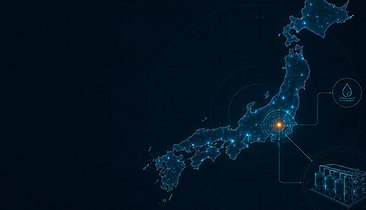
Through an independent third-party operator, the technology is fully operational in Japan and is supporting active water-treatment applications.
This deployment provides real-world operational experience that can inform the engineering, configuration and implementation of future commercial systems.
Future cities will require integrated systems capable of recovering, treating and reusing water across residential, commercial and industrial environments.
Wharton’s water-treatment platform can support resilient infrastructure through distributed treatment, drinking-water production, industrial reuse, closed-loop recovery and final water polishing.
When integrated with Wharton energy and infrastructure technologies, the platform can contribute to more self-sufficient communities, remote developments, net-zero projects and future human-habitable cities.