

Nano-Bioengineering for Environmental Health and Community Resilience
Wharton Technologies is building a new generation of environmental and structural protection systems designed to improve the places where people live, work, travel, and gather.
Our platform brings together air treatment, surface protection, nano-engineered coatings, fire-resistant materials, coastal infrastructure protection, and healthy-building systems. Each technology is being developed as part of a larger objective: stronger communities, cleaner environments, and infrastructure prepared to serve future generations.
.png)
Integrated technologies support cleaner air, safer surfaces, and more controlled environments.
AIR & SURFACE PROTECTION
Wharton Technologies is developing integrated systems for managing airborne particles and surface contamination in commercial, institutional, industrial, transportation, and community environments.
Our approach combines advanced filtration, HVAC integration, controlled air movement, environmental monitoring, and electrostatic surface application. These technologies are designed to work together as one coordinated protection platform rather than as isolated products.
The goal is clear: create indoor environments that are easier to monitor, maintain, clean, and protect.
ELECTROSTATIC APPLICATION TECHNOLOGY
Electrostatic application technology charges fine liquid droplets as they leave the sprayer, helping the applied material reach exposed, vertical, recessed, and irregular surfaces.
Wharton is advancing this application method for large facilities, high-contact areas, transportation systems, industrial environments, and critical infrastructure.
The complete system combines application equipment, proprietary material development, controlled operating procedures, and measurable treatment conditions. Performance will be documented for the specific formulation, surface, application method, and operating environment being used.
.png)
Charged droplets provide controlled coverage across complex and high-contact surfaces.
.png)
ADVANCED AIR-HANDLING SYSTEMS
Air quality depends on how air enters, moves through, and leaves a building.
Wharton is developing air-management systems that combine filtration, airflow control, HVAC integration, particle management, and localized treatment technologies. These systems are intended to support cleaner indoor environments while working with the mechanical requirements of the building.
Each installation is designed around the space it serves, including its size, airflow, occupancy, filtration capacity, and operating conditions.
Engineered filtration and airflow systems improve indoor environmental quality.
NANO-ENGINEERED PROTECTIVE COATINGS
Wharton Technologies is developing nano-engineered coatings for structural, environmental, and high-contact applications.
These coatings are being designed to protect selected materials from moisture, corrosion, salt exposure, surface contamination, abrasion, and other environmental stresses. Research also includes advanced coatings for walls, beams, concrete, masonry, metals, and infrastructure components.
Our objective is to create protective surfaces that are more durable, easier to maintain, and better suited to demanding environments.

Advanced coatings protect structural materials from moisture, corrosion, abrasion, and contamination.
.png)
COASTAL & STRUCTURAL PROTECTION
Coastal and oceanfront structures face constant exposure to salt, moisture, wind, heat, movement, and corrosion.
Wharton is developing protective treatments for concrete, aggregate, masonry, reinforcement, joints, cracks, and structural transition points. The program focuses on reducing moisture penetration, limiting salt-related deterioration, protecting embedded materials, and extending the useful life of critical infrastructure.
This work is intended for seawalls, ports, bridges, waterfront developments, transportation systems, industrial sites, and future coastal communities.
Protective treatments help defend concrete and infrastructure against salt, moisture, and corrosion.
FIRE-RESISTANT STRUCTURAL SYSTEMS
Wharton is advancing fire-resistant coatings and building-envelope systems for steel beams, concrete members, walls, equipment spaces, and critical infrastructure.
These systems are being developed to slow heat transfer, protect structural materials, support safer building assemblies, and improve resilience during high-temperature events.
The research combines advanced coatings, mineral and composite materials, engineered application thickness, substrate preparation, and complete assembly design. The result is a coordinated protection system rather than a conventional paint product.
.png)
Advanced materials help protect beams, walls, and critical structures from extreme heat.
.png)
HEALTHY-BUILDING SYSTEMS
Wharton’s healthy-building platform connects air quality, surface protection, structural durability, fire resistance, water, energy, and environmental monitoring.
Instead of treating each system separately, we are designing buildings and community infrastructure as connected environments. Air systems support healthier interiors. Protective coatings strengthen the structure. Water and energy systems maintain essential services. Monitoring systems help operators understand conditions and respond before minor issues become larger problems.
This integrated approach creates facilities that are safer, more efficient, easier to maintain, and better prepared for long-term operation.
Wharton advances each system through testing, measurement, and controlled development.
NATIONAL HEALTH & COMMUNITY PREPAREDNESS
Wharton’s 10,000-Year Community Preparedness vision is a long-range approach to infrastructure, public health, and community continuity.
It does not mean that one coating, machine, or building will operate unchanged for thousands of years. It means communities should be designed so that essential systems can be inspected, repaired, renewed, and upgraded from one generation to the next.
Our work focuses on durable structures, cleaner indoor environments, resilient water and energy systems, emergency operating capacity, replaceable components, and infrastructure that can adapt as technology advances.
The objective is not simply to build for today. It is to create a foundation future generations can continue improving.
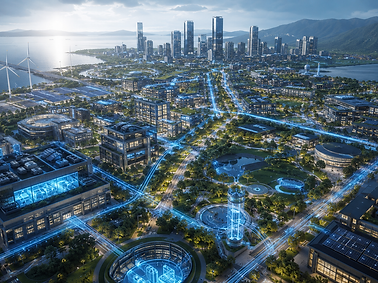.png)
Connected infrastructure supports healthier environments and stronger long-term communities.
ACTIVE RESEARCH & VALIDATION
Wharton Technologies is actively advancing this platform through materials development, engineering design, laboratory testing, system integration, and controlled deployment planning.
Our current work includes:
Air and filtration system development, electrostatic application testing, coating formulation, material compatibility, corrosion and moisture resistance, thermal protection, surface performance, environmental monitoring, and integrated building-system design.
Performance claims will be connected to completed testing, defined operating conditions, and appropriate technical documentation. This approach allows Wharton to move aggressively while maintaining the scientific and engineering discipline required for responsible deployment.
PROGRAM VISION
Wharton Technologies is bringing together environmental engineering, advanced materials, infrastructure protection, and long-range community planning into one coordinated technology platform.
We are developing systems that protect the air around us, the surfaces we touch, the structures we depend on, and the communities we are preparing for the future.
Building the Next Generation of Resilient Communities
Wharton Technologies welcomes discussions with government organizations, infrastructure developers, engineering firms, laboratories, facility operators, and strategic partners.