
Aerospace Information
The documentation below contains confidential research information intended solely for authorized persons. The data, methodologies, and findings presented herein are proprietary and may not be disclosed, copied, or used without prior written consent from Wharton Technologies or RC Manufacturing and Nanotechnologies INC. Unauthorized use or distribution of this document is strictly prohibited and may violate institutional and legal confidentiality agreements.
Darpa
Wharton Technologies is preparing to enter the DARPA Drone Challenge, supporting our continued focus on advancing next-generation unmanned aerial systems and energy-enabled flight architectures. Participation in this challenge reflects Wharton’s commitment to solving complex aerospace engineering problems where endurance, efficiency, and onboard power availability are critical to mission success.
Through this initiative, Wharton Technologies aims to demonstrate capabilities in:
-
Advanced UAV power system engineering
-
Endurance-focused energy architecture
-
Onboard prime and supplemental power integration
-
Rapid design, testing, and validation under mission-driven requirements
Entering the DARPA Drone Challenge represents an important step in validating scalable energy solutions designed to support future aerospace and autonomous platform development.
Drone agricultural spreading.


Our products are built to withstand extreme temperatures.
Can operate in temperatures as low as -60°C and as high as +270°C

Lamination of Aerospace parts along with cold fusion laminating systems.
Global Production & Validation Capability
With over 25 years of engineering experience and access to more than 1.5 million square feet of production facilities worldwide, Wharton Technologies supports the development, manufacturing, and scaling of advanced aerospace power systems.Secure locations, dedicated flight test areas, and controlled integration environments enable efficient transition from concept development to validated, production-ready deployment for high-demand aerospace partners.
M.I.G. System
Technical Highlights & Specifications
The M.I.G. (Micro Induction Generator) is a compact LENR-based prime or supplemental onboard energy system designed to provide dynamically regulated power for aerospace and advanced autonomous platforms. The architecture supports integration with existing electrical systems and propulsion environments, delivering scalable onboard energy intended to reduce battery dependency and extend operational endurance.
🔹 Core Performance Highlights:
-
LENR-based onboard energy generation architecture.
-
Prime or supplemental power capability.
-
Dynamic output responsive to system load demand.
-
Designed for scalable implementation depending on platform requirements
-
Rapid load-change response characteristics.
🔹 Electrical & Integration Characteristics:
-
Platform-configurable output architecture.
-
Designed for integration with existing aerospace electrical systems.
-
Compatible with low, medium, and higher-voltage DC bus architectures.
-
In-flight start and restart capability.
-
Supports continuous onboard power delivery.
🔹 Flight & Operational Capability:
-
Orientation-independent operation.
-
Stable performance during aggressive maneuvering.
-
Vibration-tolerant design.
-
High-altitude operational compatibility.
-
Load-responsive power regulation during changing flight conditions.
🔹 Environmental Specifications:
-
Operational temperature range: approximately −60 °C to +270 °C
-
Dust, water, and saltwater resistant architecture.
-
Designed for harsh aerospace and autonomous environments.
🔹 Reliability & Safety:
-
Projected operational service life: ~13 years.
-
Integrated power regulation and protection controls.
-
Failure containment design.
-
Emergency shutdown capability.
🔹 Operational Advantages:
-
Reduced battery discharge rate.
-
Extended mission endurance.
-
Improved platform energy management.
-
Increased operational flexibility.
-
Faster turnaround between missions.

M.I.G. attached to drone arm.
M.I.G. integration video
Hydrogen On-Demand — Expansion Into Aerospace Platforms
.png)
Hydrogen powered parabolic impeller.
30,000 lbs lift capacity.
Building on a long history of developing hydrogen on-demand energy systems for prime power applications, including gigawatt-scale platforms, Wharton Technologies is expanding its energy architecture into the aerospace sector. Our experience in large-scale power generation and energy management provides a strong technical foundation for adapting hydrogen technologies to advanced aviation environments where efficiency, endurance, and onboard energy flexibility are critical. By translating proven prime power principles into aerospace applications, Wharton Technologies is integrating its hydrogen on-demand technology into next-generation aircraft concepts to support hybrid, hydrogen-assisted, and future propulsion architectures designed for scalable commercial deployment.
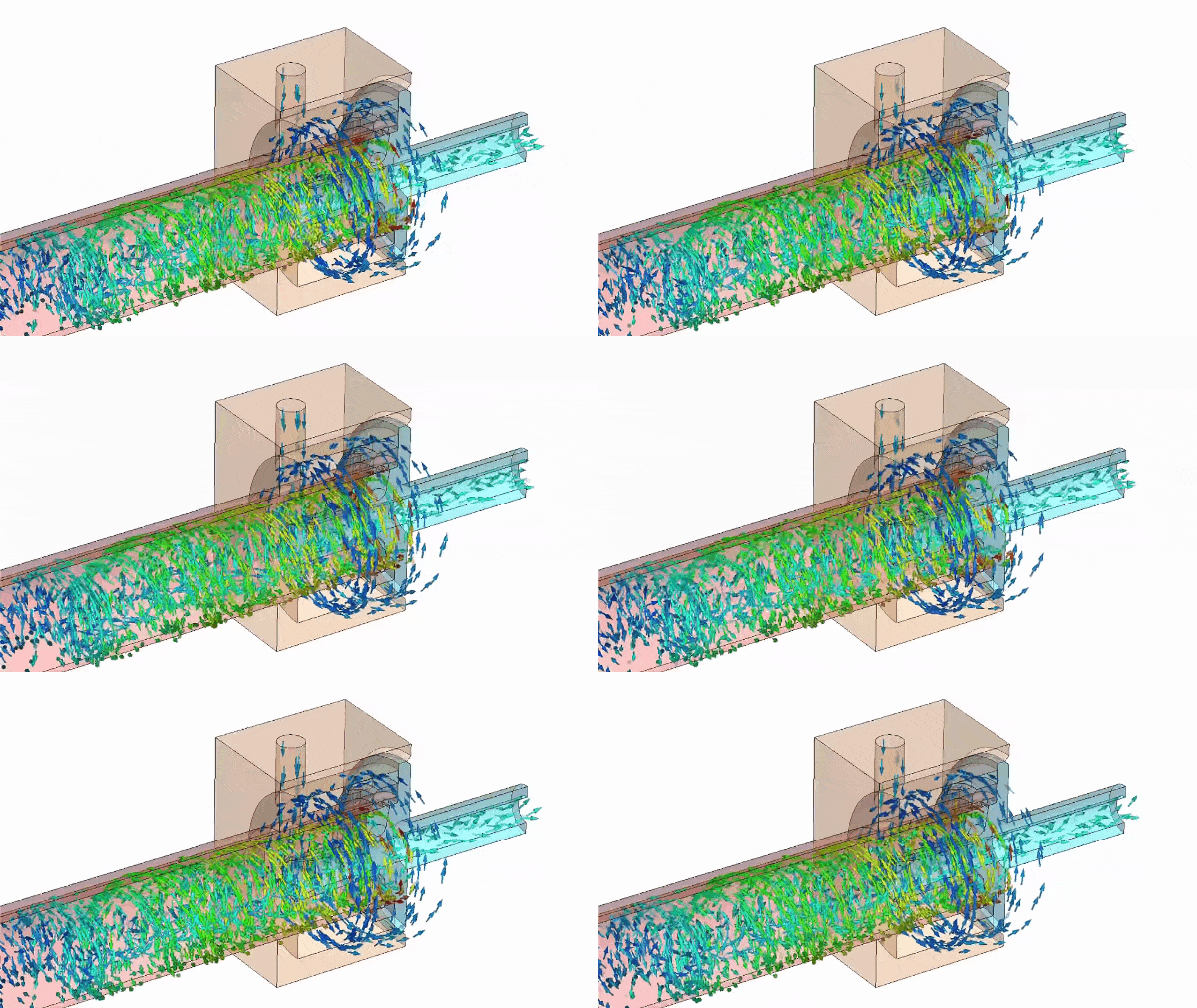
Vortex energy diagram.
_edited.jpg)
To obtain pricing information on our products, please click the image to the left to download.